HYDROSTATICALLY DRIVEN ROLLERS
The operator enjoys the incredible comfort of a proportionally adjustable hydrostatic transmission. There is no need to disengage; the operator can adjust the speed steplessly at any time. ELIET deliberately chose a dual hydrostatic system here, giving the hydraulic motor in each of the front rollers the luxury of having a separate pump. As a result, each hydraulic motor can also be controlled individually and proportionally. The operation of the rollers is linked to a movable steering wheel. When the steering wheel is turned to the left, this translates into a traction difference between the left and right front rollers, causing the machine to turn to the right. The further the steering wheel is turned, the greater the speed difference between the left and right rollers and the sharper the turn becomes. This makes steering very intuitive, acting as a natural movement, allowing the operator to sow in a controlled manner right into the smallest corners. This makes the new ELIET lawn seed drill extremely suitable for the creation of private gardens with limited access and complex shapes.
SPACIOUS SEED BOX
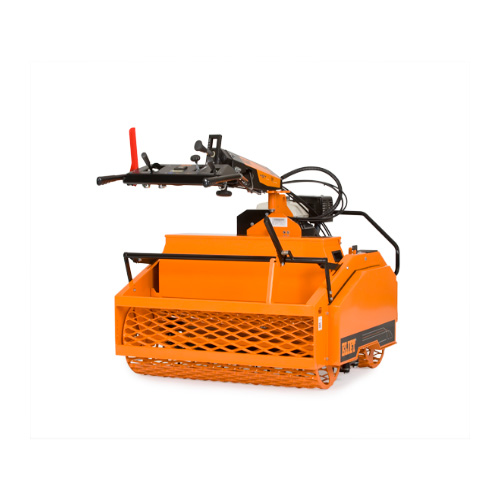
The seed hopper has a capacity of 61 L (GZC 750) or 93 L (GZC 1000). The seeding rate can be adjusted from 0 to 100 g/m². A rotary mechanism inside the seed hopper ensures a continuous and even flow of grass seed. The seed hopper has the same seeding width as the rotary harrow. Because the seed hopper is positioned in front of the rotary harrow, the linearly dispersed seed is spread across the entire working width. This way, you are not faced with unsightly seed lines.
WORKING WITHOUT A SEED BOX
The seed hopper is a separate component suspended freely within the machine. This means that during preparatory leveling work, it is preferable to remove the seed hopper from the machine to obtain a better view of the rotary harrow. It also prevents stones that might be stirred up during leveling from damaging the seeding unit. For those who wish to leave the seed hopper in the machine, a second, higher, and securely positioned suspension point is provided.
SEED DISTANCE SCHEME
When laying a new lawn, major seed manufacturers recommend a spreading rate between 20 g and 30 g/m² for ornamental and sports lawns. Naturally, seed size varies, so the flow rate through the seed hopper openings will differ depending on the composition of the mixture. Permanent breeding programs for varieties ensure that seeds continue to evolve. Recent innovations in growth-accelerating coatings on grass seeds also mean that mixtures recommended today will be outdated in a few years. It is therefore important that a seed drill features seed flow control that can effortlessly accommodate this rapid evolution. That is why ELIET has a fine-tuning setting with 36 positions on its seed drill. This wide range allows the opening of the spreading nozzles to be adjusted very precisely.
SLIP CLUTCH
During seedbed preparation, stones are often churned up from the subsoil by the rotary harrow. A larger stone can accidentally become lodged between the rotary harrow and the rear roller. To prevent this blockage from causing a break in the drive mechanism, it is protected by a slip clutch.
MACHINE-WIDE ROLLERS
The ELIET lawn seed drill is equipped with two crumbling rollers at the front and a machine-wide crumbling roller at the rear. This ensures good weight distribution and that the soil is compacted evenly everywhere. Since the rollers have an open profile, they roll the soil without compacting it at the surface. As a result, the soil remains sufficiently airy, allowing water and nutrients to seep through adequately. Erosion after heavy rain is also prevented.
ROBUST CONSTRUCTION
A high machine weight is essential for proper operation. The weight-reducing measures taken by ELIET yield optimal results for the user, as they turn the GZC into an indestructible armor. With plate thicknesses of 5 to 20 mm, it goes without saying that operational reliability is guaranteed. Above all, the machine's construction remains simple and maintenance-friendly.
SIDE-ADJUSTABLE HANDLEBAR
To guarantee a perfect ground finish during sowing where even the operator's footprints are no longer visible, ELIET has provided a feature that allows the steering wheel to be adjusted laterally. Compared to the standard steering setup, the operator can assume a fixed position rotated 20° to the left or right. This allows him to walk alongside the machine while still retaining the functionality of the Intuitive Steering™. To remove the seed hopper, the steering wheel can even be swung a full 90° to the left.
DEPTH SETTING SHAKER
One of the machine's most important controls is the lever for adjusting the depth of the rotary harrow. To thoroughly loosen the soil and prepare the seedbed with the appropriate grain size, the user can continuously adjust the depth setting of the rotary harrow. To switch smoothly between the 6 depth settings, the lever is within easy reach of the operator.
LIFTING HOOK
Freight transport legislation is becoming increasingly strict. For instance, certain European Member States require that a machine be equipped with at least 4 anchoring points for safe transport. In accordance with these regulations, the ELIET GZC is equipped with such an attachment point in each corner of the chassis. Furthermore, a lifting eye is provided centrally on the machine to allow it to be lifted with a crane.
SHUDGE
The rotary harrow consists of two rows of tines that sink into the ground to a maximum depth of 7 cm. It is one of the most important components of the machine because it performs three essential operations: breaking up the topsoil, leveling the terrain, and incorporating the seed. The drive of the rotary harrow can be switched off. This is important for safe transport to and from the workplace, and for loading and unloading.
INTUITIVE STEERING
The GZC's steering wheel is a laterally movable one. By pushing the steering wheel sideways, a simple yet ingenious mechanism translates this movement into a control signal for the hydrostatic drive of the front rollers, causing the machine to turn in the direction with the dynamics the operator had envisioned when performing the steering movement. The steering wheel is easy to operate yet provides a certain counter-pressure, so that it feels right and corresponds to the energy required to turn a machine weighing over 400 kg.

 Nederlands
 English
 Français