
 Nederlands
 English
 Français
Is there a memory effect in modern batteries?
We explain what is behind the so-called memory effect and whether it still occurs in modern lithium-ion batteries.
What does the memory effect mean?
It is often said that every battery suffers from the 'memory effect' and that the battery becomes less powerful if it is charged too quickly. As the performance of the battery decreases the lifespan of the device's battery will automatically decrease. The result: the battery has to be charged more and more often and in the worst case the battery becomes unusable prematurely. But is it true that all batteries suffer from this loss of capacity? With modern lithium-ion batteries the memory effect is no longer noticeable; they therefore do not suffer from the 'li-ion memory effect'. For the user this has the great advantage that he can always charge the battery regardless of the charge status.
The memory effect of batteries was discovered in the 1960s
The original battery myth is based in fact and once posed a real challenge. The memory effect was discovered in the 1960s by NASA engineers. They noticed that the batteries of a satellite lost capacity over time. After the batteries had been partially discharged several times they only delivered as much energy as when they had been charged.
The 'memory effect' therefore refers to a negative change in storage capacity that occurs as a result of repeated partial discharges. The battery 'remembers' the partial discharge state and only makes the amount of energy that it 'remembers' available for later use. You can compare it to a barrel in which you place a second base halfway. The space that you can fill in the barrel becomes smaller. Electrically the memory effect manifests itself as a voltage drop. If the voltage drops below the minimum that the device needs due to voltage drop the battery becomes unusable.
Memory Effect: Which Batteries Are Affected?
The memory effect occurs mainly with nickel-cadmium (NiCd) batteries which are often used in wireless devices. The effect occurs because crystals form on the cathode which consists of cadmium. If the battery is not fully discharged more and more crystals will form in the non-discharged part. In addition the voltage decreases as the crystals become larger because the material becomes less conductive. A similar effect is observed to a lesser extent with nickel-metal hydride (NiMH) batteries. In this case we speak of the "lazy battery effect". Common AA or AAA batteries are still NiMH batteries. This also applies to batteries that are permanently built into small electrical devices. Elsewhere you will find few NiMH and NiCd batteries.
How does the memory effect arise?
According to the current state of research the memory effect is based on two processes.

No “memory effect" with STIHL lithium-ion batteries
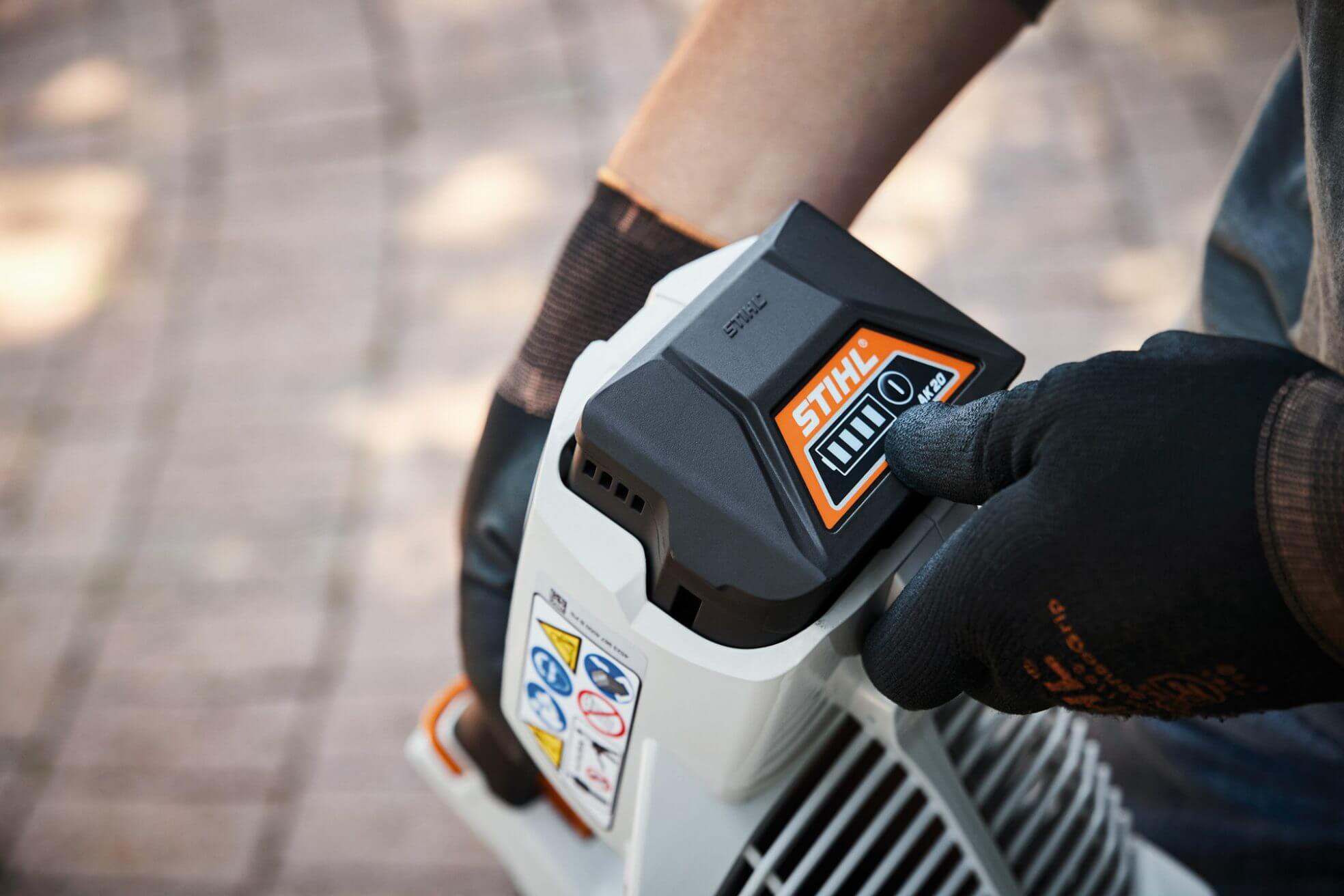
STIHL uses only modern lithium-ion batteries. Not only are they lighter and more powerful than their predecessors they also do not exhibit any "Li-ion memory effect." This means that even after repeated partial discharges there is no significant drop in voltage. We can guarantee this thanks to the materials we use for the production of the battery cells and because we use the latest technology. You can charge STIHL Li-ion batteries at any time without any problems regardless of whether you let the battery run down completely or not. You can also charge the battery during a break from work.
What is the memory effect in batteries?
In the past nickel-cadmium (NiCd) or nickel-metal hydride (NiMH) batteries were often used. If these batteries are only partially discharged several times their capacity decreases. This effect is called the memory effect. Due to frequent partial discharges the battery "remembers" the energy requirement of the last charging sessions. It is only charged up to the amount of "stored" energy and no longer up to the initially available capacity. This causes a premature voltage drop which ultimately makes the battery unusable.
Summary: The memory effect in batteries
- The lithium-ion batteries in STIHL machines have no memory effect.
- The memory effect only occurs with 'old' batteries such as NiCd batteries.
- The memory effect occurs when non-discharged batteries are charged too quickly.
- Due to the memory effect energy capacity is partially reduced or even completely lost.