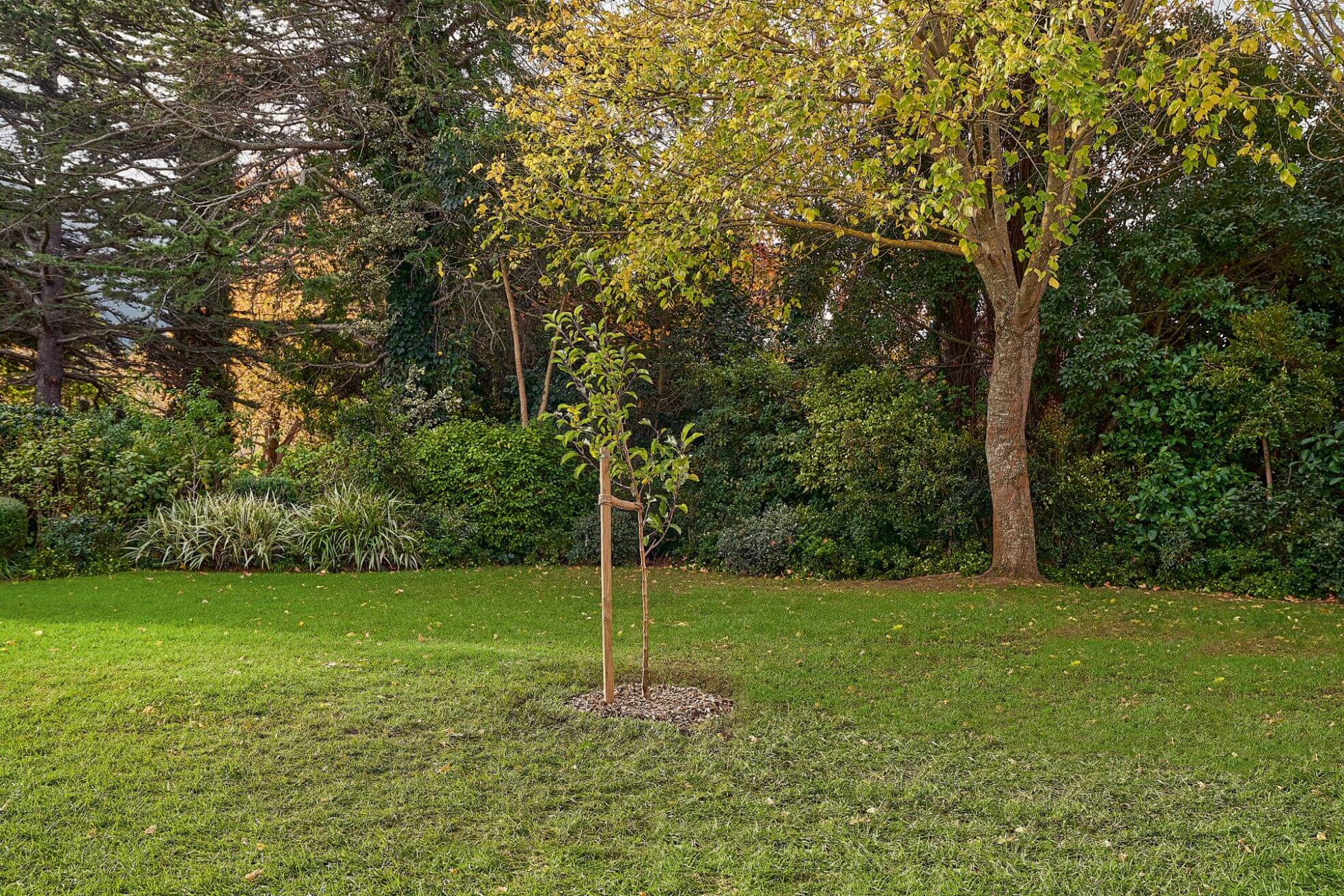
Trees provide shade and shelter for animals and are the 'green lungs' of our planet. Here's how to plant trees.
Overview: Plant a Tree
In this article you will learn how to prepare the soil and tree for planting and how to plant properly.
Trees produce oxygen and purify the air of harmful substances. They form an important habitat: they provide food for many living creatures and protect the soil from drying out.
Nurseries sell three types of trees: potted trees trees with a root ball and trees with bare roots.
When choosing a location consider:soil qualitytree size and crown diameter. Also keep the necessary distance to the plot boundary.
After planting it is important to water and mulch the tree well.
You can plant trees in your garden that suit the quality of the soil and the size of your garden. Butterfly bushes and laburnum are suitable for chalky soil. In a dry place rough birch and Norwegian maple feel at home. Crab apple trees and winter lime trees thrive in loamy soil. In a large garden you can plant cherry chestnut or beech trees. In a small garden spherical acacias columnar ornamental cherries and small standard trees come into their own better.
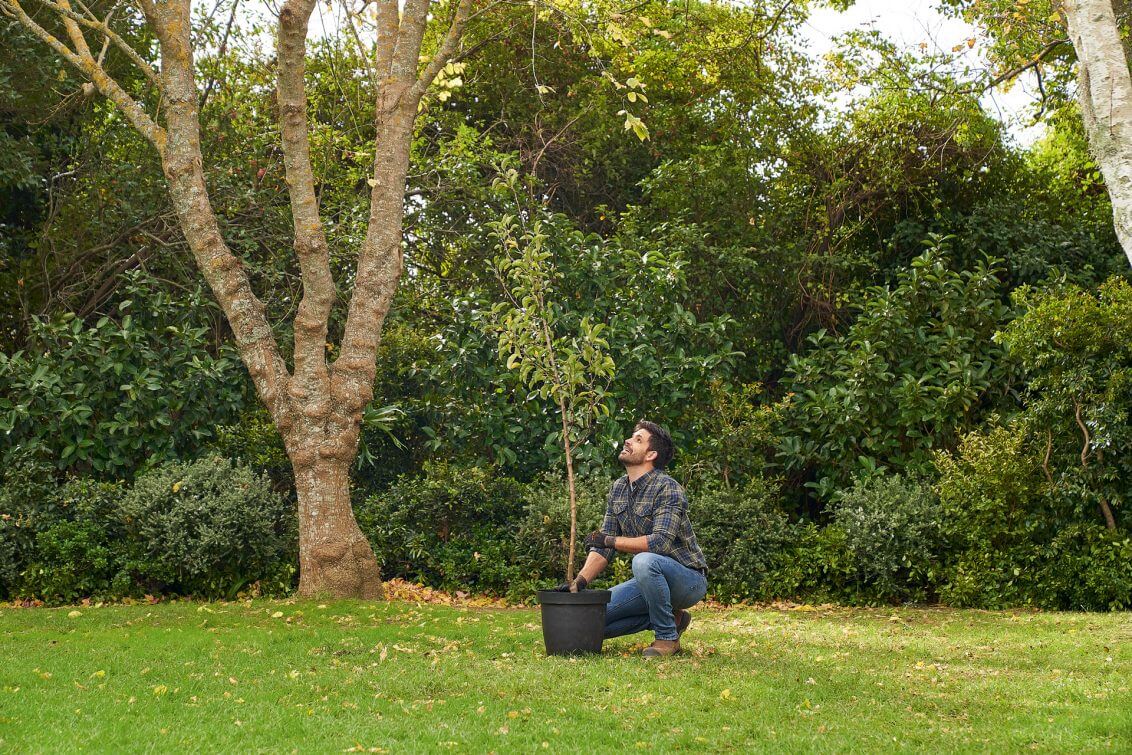
How do you plant a tree?
You plant a tree by digging a planting hole in the right place placing the tree in the middle and filling the planting hole again. Newly planted trees also need support. Finally water the planted area generously and cover the soil with mulch.
How big should the space be for trees?
The planting hole for a tree should be about twice as wide and slightly deeper than the roots. This gives the tree enough space to form strong roots.
When can we plant trees?
Trees can be planted in spring or autumn. So it is not too cold and not too warm. The best time is autumn between the end of September and the beginning of October: the summer green trees have then lost their leaves and do not evaporate as much water which is good for growth.
Why is it important to plant trees?
Besides their decorative function trees are an important part of our ecosystem:
Trees produce oxygenpurify the air of harmful substances and absorb large amounts of carbon dioxide that is harmful to the environment. Trees are therefore essential for all living beings on earth and contribute to combating rapid climate change.
Trees provide habitat for animals and birds. Many species find food nesting places and shelters there. Leaves and fruits such as berries and nuts are a food source for humans and animals. Bees bumblebees and other insects feed on the pollen and nectar of flowering trees.
The trees provide pleasant shadeunder which people and animals can escape from the sun.
Planting trees: preparation
Before you start planting you need to think about what kind of tree you want and where you want to plant it. The right planting time is also crucial for the health and growth of the tree.
Choose the tree you want to plant
In general nurseries offer three types of trees:
Potted tree:These are trees that grow in potting soil and larger flower pots also called containers. They are available all year round even when they are in full bloom. When buying look for healthy high-quality finely branched tree roots. Some trees are planted in pots to sell them instead of being grown in them. This gives them smaller root balls.
Tree with root ball:These are trees that are grown in the field and are taken from the ground with a root ball. The roots remain relatively intact and are wrapped in burlap or plastic that holds the soil together. If the cloth is burlap and not plastic it is planted with the tree. The burlap is then broken down in the ground. Larger trees conifers and evergreens are often available with root balls. These are available from October through March.
Bare root trees:These trees come straight from the field and are delivered with bare roots i.e. without soil around the roots. Bare root trees are only available in spring or autumn. In spring the trees offered are taken from cold stores. They are therefore only available without blades. Conifers and evergreen trees are not available in this form otherwise they would dry out in no time.
Which trees can I plant to combat climate change?
In principle you can plant any tree to combat climate change because every tree produces oxygen and filters carbon dioxide from the air. It is best to plant native trees that thrive in your environment and do not consume many resources.
How much does it cost to plant a tree?
How much does it cost to plant a tree?
The costs vary per tree and depend on many factors. Think for example of the price of the tree the costs of the subsequent work and care or possible measures to improve the soil quality.
The best time to plant trees
Usually you can plant a tree in spring or autumn. In these seasons it rains more than in summer. The tree then gets enough moisture and can grow better. It is not too cold and not too hot outside. The best time to plant trees is the beginning of autumn end of September to beginning of October. The green summer trees have already lost their leaves and no longer evaporate water. This gives them enough strength and time to root before winter arrives.
Suitable place to plant a tree
Good soil conditions are important to ensure that the tree thrives and grows healthily. Before choosing plants check the soil type in your garden and choose a crop that is suitable for that soil type. Unlike smaller shrub beds it is more difficult to improve the soil under a tree later and transplant a tree.
Dry soil
Tree species:
Norway maple
Field Maple
Winter linden
rough birch
Cherry
Larch
Summer oak
Common Maple
Summer linden
Walnut
Limestone soil
Tree species:
Butterfly tree
Laburnum
Yellow dogwood
Dogwood
Elderberry
Weigela
Ginkgo
Common silver fir
Robin
Clay soil
Tree species:
Winter linden
Common Magnolia
Crabapple
willow
cherry plum
Summer oak
Poplar
Privet
Laburnum
Charm
When choosing a location you should also consider the final size of the tree and the diameter of the crown. You can find this information in the plant description or in a garden centre. This will allow you to estimate in advance how much shade the tree will provide and how far you should place it from your house other plants or the boundary of your property. You can determine the best location for a smaller tree species using a branch or slat: take a branch that is as long as the maximum height of the tree and place it vertically. This will allow you to visually imagine how the tree will grow and how high it will become.
Incidentatlly: Regular sizekeeps the tree fit instead of small. Therefore in small gardens plant smaller tree species such as a bolacacia a column cherry or a small tree on a trunk. The soil must also be weed-free before you plant.
Tree on the property line
The minimum distance to the plot boundary is set out in the Neighbourhood Act and varies by country. The general rule is: the wider and higher the tree the greater the distance to the neighbours must be. Therefore always check with your municipality if you want to plant a tree.
Where can I plant a tree?
If you own land you can plant a tree there. Please take into account the boundaries of the plot and local regulations. However planting trees is not permitted on roads fields forests and other public spaces.
Dust (as a digging base when planting a tree in the lawn)
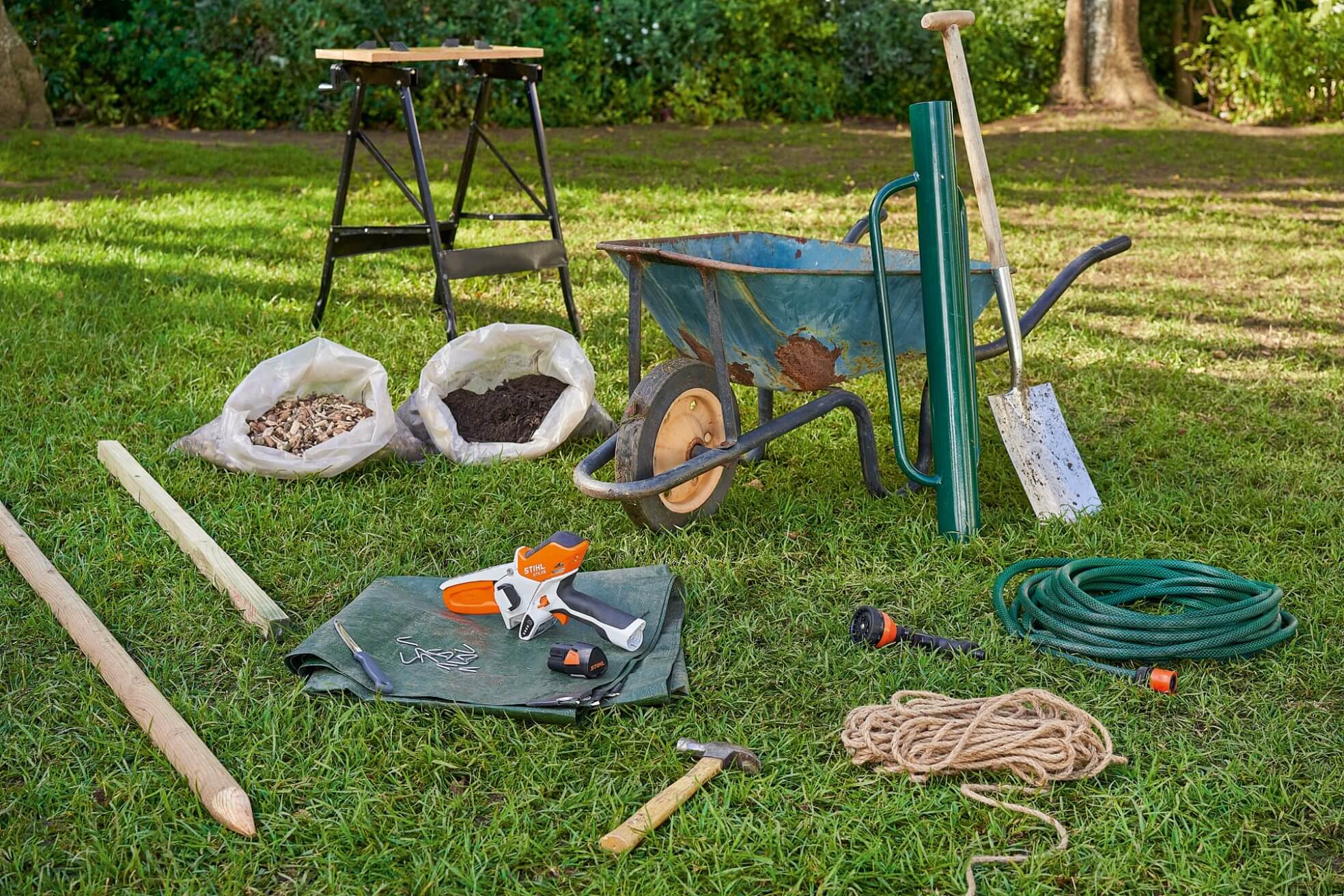
Required machines and tools:
Pruning saw (e.g. STIHL GTA 26)
Rubber hammer
Hand health
Spade or fork for heavy soil
Knife for potted trees
Garden hose with spray nozzle
Wheelbarrow
Gloves
Safety equipment:
Working with powerful machines is fun and ensures that you can perform optimally. But you also need to be able to rely on effective and safe protective clothing. Always wear your personal protective equipment when working with garden tools. Think of cut-resistant gloves safety glasses hearing protection and more. For more information please refer to the product manual. Before using the machine for the first time you should know how to operate it and ensure that the machine is in perfect condition for each use. On request your STIHL dealer will be happy to prepare your machine for its first use. He will also advise you on the types of protective clothing that you can try on at your leisure. Please note that personal protective equipment is not a substitute for safe working practices.
First water the tree. To do this place the tree in a container or bucket filled with water until no more air bubbles are visible. For pots that are too large and cannot be submerged in a bucket you can water the root ball and then thoroughly moisten it after planting.
Step 2: Prepare the planting area
Measure the planting hole and remove any weeds. The planting hole should be about twice as wide and slightly deeper than the root ball. This gives the tree enough space to form strong roots. You can check the size and depth of the hole with a wooden strip. To do this first saw the strip to the desired length with a pruning saw (e.g. STIHL GTA 26).
First remove the area of lawn where you want to plant the new tree. To do this remove the grass within a radius of 198 to 50.01 cm around the trunk (depending on the size of the tree at the time of planting). Place a tarp or drop cloth around the planting hole to prevent the grass from being pulled up next to it.
Step 3: Dig the planting hole
Dig the planting hole and put the soil on the cloth. Loosen the edges and bottom of the hole a little with a fork or spade. Mix the excavated soil with potting soil or compost. This is especially important if the soil is too sandy or too loamy. Be careful not to use too much potting soil. This mix is only intended to help the tree grow until it starts to develop roots in the garden soil.
Step 4: Stimulate root growth
For potted trees cut about 1.97 inches into the roots outside the root ball with a sharp knife. This will allow the tree to grow new roots that will reach into the ground. Otherwise the roots of potted trees will continue to grow in a spiral pattern and will not be stable for years.
Step 5: Positioning the tree and pole
Place the tree in the planting hole place it in the middle and determine the correct depth with the stick. To do this place the lath over the planting hole so that the future ground surface is created. The hill may be a maximum of 3 2 286.00 cm below the ground. For a fruit tree the grafting point is a typical thickening at the bottom of the trunk that is grafted by the grower at approximately 39 1 016.00 cm above the ground. Add or remove some soil if necessary.
Step 6: Place the tree stake
Now place the tree stake. The position of the tree stake is based on the tree trunk: directly next to the root ball in the main wind direction. Then remove the tree from the hole and hammer the stake into the ground at the marked spot with a hand ruler.
The insertion depth depends approximately on the height of the crown. The stake ends 394.00" below the main branches. This is where you secure the tree. In strong winds stakes that are too long can damage the bark of the branches. Poles that are too short do not provide sufficient support for the tree. If in doubt it is best to buy slightly longer stakes and drive them deeper into the ground. If this does not work saw off a piece with a pruning saw.
Step 7: Plant a tree
Now place the tree in the middle of the hole next to the stake and straighten it. When growing fruit trees you should pay attention to the graft point: this is a typical thickening at the bottom of the trunk that has been grafted by the grower and that must remain above the ground.
Pots made of natural materials can be left in the planting hole where they will decompose over time. Remove plastic and pots.
Then fill the planting hole with the remaining potting soil. Shake the tree occasionally so that the mixture is evenly distributed over the roots. If the soil is too dry fill the planting hole three-quarters full with soil and then water it well. Now press the soil lightly.
Please note: if the soil is too compact no more air can pass through and the tree roots can no longer breathe.
Step 8: Secure the tree properly
To keep the planted tree stable you will need to tie it to a support. To do this wrap a coconut rope in a figure eight around the tree trunk and the stake (approximately 12 to 3 94 inches below the end of the stake). Tie the rope loosely to the tree side and slightly higher than the stake. Over time the tree will sink into the ground which will automatically level the rope. The rope will remain on the tree for approximately 2 to 3 years and will eventually come loose.
Step 9: Water and fertilize the tree
Now create a water rim around the filled planting hole and fill the planting hole with plenty of water. Once the liquid has been absorbed into the soil cover the area around the tree with a layer of horn chips and then with a layer of bark mulch. This will protect the soil around the tree from evaporation and keep it moist for longer. Cover the surface with mulch again in the spring.
The soil around the tree the so called tree disk should be kept loose or mulched especially during the first 5 to 6 years after planting. The tree disk should be slightly larger than the tree crown i.e. a radius of about 127 to 59.00 cm. After that the grass can grow at the trunk.
Special Considerations When Planting Trees with Exposed Root Balls and Roots
When planting atree with root ballLoosen the fabric unfold it wide and remove it if possible. Fabrics made of natural materials can be left in the planting hole where they will decompose over time. In any case there should be no string or wire hanging from the trunk of the tree. Also remove plastic materials. After planting the base of the trunk should still be approximately 24.99 cm above the ground.
Planting locationtrees with exposed rootsPlace the pot in a bucket or container with water for a few hours and let the roots absorb enough water. Before planting cut off any twisted or dead roots with pruning shears. Note: the plant must fit well in the planting hole without the roots bending. Do not plant the plant directly in firm garden soil.
Tree anchoring: which support for which tree?
The type of support depends on the shape and size of the tree.
A vertical pole in the main wind direction
For which trees?Small trees with exposed roots on the trunk and trees with a small root ball in a pot (e.g. fruit trees).
How?First drive the stake into the ground in the main wind direction and then plant the tree. The stake can be close to the trunk.
A leaning pole
For which trees?Low-crowned trees (young plantations or multi-stemmed trees) multi-shoot trees and conifers.
How?Place the pole against the wind direction and at a sufficient distance from the root ball. Push the bracket into the ground at an angle of 45°. Bend the tree for protection and secure the pole even more firmly. If necessary shorten the pole so that it protrudes a maximum of a hand's width. Then secure the pole.
Tripod (three poles connected by crossbars)
For which trees?Large trees with a high trunk and root ball where the poles cannot reach the trunk without damaging the root ball.
How?First plant the tree and then place the poles in a triangle with sufficient distance to the trunk. Connect the support poles with cross beams and attach them to the tree.

 Nederlands
 English
 Français